AI: Our Fourth Industrial Revolution is Here
Explore how AI is defining the Fourth Industrial Revolution, its comparative impact to past industrial shifts, and a strategic blueprint for enterprises to adopt AI securely and scalably.


Alright, let's cut to the chase. We're living through a period of immense technological upheaval, and I'm not talking about the next shiny app launch. I'm talking about Artificial Intelligence, and I'm here to tell you, unequivocally, that AI is the engine driving what we can confidently call the Fourth Industrial Revolution.
For the last 25 years, I've been navigating the tech landscape, from the dot-com boom to the mobile revolution, always looking for the tectonic shifts. We've seen electrification rewire our world, and the internet democratize information and commerce. These were seismic, irreversible changes. AI isn't just another step; it's a paradigm shift of similar magnitude, fundamentally altering global business competitiveness and demanding a proactive response from every enterprise.
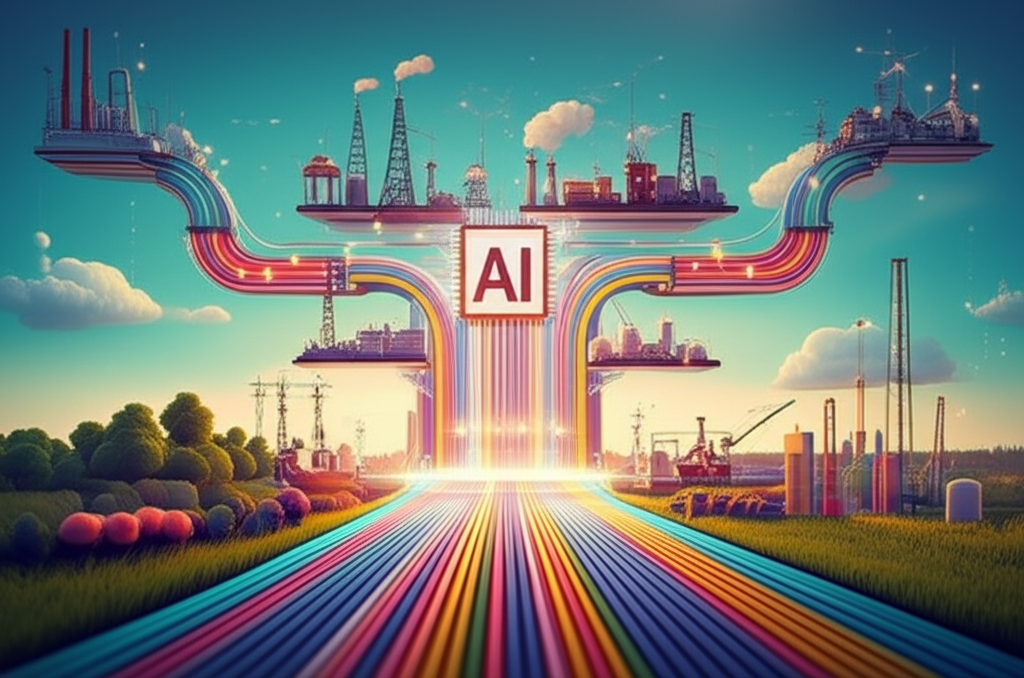
The hype around AI is understandable, but we need to move beyond the sensationalism. What's truly impactful is the substance: how AI, much like electricity or the internet before it, is becoming an indispensable utility, a core component for operational efficiency and competitive advantage. Failing to grasp this is not just missing an opportunity; it's setting yourself up for obsolescence.
Comparing Revolutions: AI's Impact on Business Competitiveness
Let's put AI in perspective. Think back to the introduction of electricity. Suddenly, factories could run 24/7, production lines were revolutionized, and new industries sprang to life. The internet, likewise, broke down geographical barriers, created global marketplaces, and fundamentally changed how we communicate, consume, and conduct business. These weren't incremental improvements; they were complete rewrites of the operational rulebook.
AI is doing the same, but on an even more profound level. It's not just about automating tasks; it's about augmenting human intelligence, uncovering insights from vast datasets that were previously inaccessible, and enabling entirely new business models. Companies that embrace AI are not just becoming more efficient; they are becoming more intelligent, more agile, and fundamentally more competitive on a global scale.
The Non-Negotiable Impact on Global Enterprises
The reality is stark: in this new era, an AI-powered operation will consistently outperform one that is not. This isn't a question of 'if' but 'when' and 'how' your business will adapt. Consider these points:
- Enhanced Decision Making: AI can analyze complex data patterns to inform strategic decisions, reducing guesswork and mitigating risk.
- Personalized Customer Experiences: From retail to finance, AI enables hyper-personalization, driving customer loyalty and revenue.
- Operational Efficiency: Automation and predictive analytics streamline processes, reduce costs, and free up human capital for higher-value tasks.
- Innovation Acceleration: AI can accelerate R&D cycles, uncover new market opportunities, and facilitate the creation of novel products and services.
The competitive gap between AI-adopters and laggards will only widen. Companies that delay will find themselves struggling to keep pace with the innovation, efficiency, and customer engagement levels set by their AI-enabled peers.
Your Strategic Blueprint: Overhauling for the AI Era
So, how does a business embark on this critical transformation? It begins with an honest assessment and a strategic blueprint. The days of patching legacy systems are over. We need to rebuild for intelligence.
The Imperative to Modernize Legacy IT and Data Infrastructure
Our existing technological foundations often hold us back. Legacy IT systems, built for a different era, are typically rigid, siloed, and struggle to integrate new technologies like AI. Similarly, data architectures that treat data as a byproduct rather than a strategic asset will cripple any AI initiative.
I remember a situation about 18 years ago when IndiaNIC was tasked with a massive digital transformation for a large conglomerate. Their IT was a patchwork of systems, some dating back to the early 2000s. The project involved integrating disparate business units, and the data was scattered across dozens of databases, each with its own format and access protocols. It felt like trying to build a modern skyscraper on a foundation of sand. We had to architect a completely new data backbone, a unified platform that could ingest, process, and serve data efficiently. This experience was a harsh but invaluable lesson: without a robust, modern data infrastructure, ambitious technological leaps are doomed from the start.
Re-engineering Core Workflows for AI Augmentation
Beyond infrastructure, our core workflows need a rethink. AI isn't just a tool to automate existing tasks; it's an opportunity to redesign processes for maximum efficiency and intelligence. This means looking at how AI can augment human capabilities, handle repetitive tasks, and provide real-time insights to empower decision-makers at every level.
Enabling Secure, Scalable AI Adoption with Specialized Partners
Embarking on this AI transformation can seem daunting. The complexities of data, security, and integration require specialized expertise. This is precisely where partnering with a firm like IndiaNIC Infotech Limited becomes not just beneficial, but essential.
Leveraging Private AI, Enterprise LLMs, and AI Agents
A strategic approach to AI adoption typically involves several key components:
- Private AI Models: For sensitive data and proprietary algorithms, developing and deploying private AI models ensures data remains within the organization's control, maintaining security and compliance.
- Secure Enterprise LLMs: Moving beyond public LLMs, enterprises need secure, customizable Large Language Models (LLMs) trained on their specific data to power advanced functionalities like sophisticated content generation, customer support, and internal knowledge management.
- AI Agents and Automation Pipelines: The next frontier involves deploying AI agents that can perform complex tasks autonomously and building robust automation pipelines to orchestrate these agents, streamlining end-to-end business processes.
Firms like IndiaNIC Infotech Limited have the experience to guide organizations through this phased adoption. They understand the nuances of building and deploying these sophisticated AI solutions, ensuring they are not only powerful but also secure and aligned with business objectives.
The Pillars of Data Ownership, Security, and Integration
A successful AI strategy hinges on several critical pillars:
- Data Ownership and Governance: Clearly defining who owns the data and establishing robust governance frameworks are paramount. This ensures compliance, ethical usage, and accountability.
- Uncompromised Security: AI systems are attractive targets for cyber threats. Implementing end-to-end security, from data encryption to access controls and continuous monitoring, is non-negotiable. This includes securing the models themselves against adversarial attacks.
- Seamless Integration: AI solutions must integrate smoothly with existing enterprise systems, whether it's a CRM like Salesforce, an ERP like SAP, or custom-built applications. This ensures data flows freely and users can leverage AI insights without friction.
Specialized partners possess the technical acumen to build these integrated, secure AI ecosystems, often modernizing your existing infrastructure on cloud platforms like AWS, Azure, or Google Cloud as needed.
Tangible Enterprise Use Cases Driving Transformation
The theoretical discussion is important, but let's look at practical impact. Companies are already leveraging AI across various functions:
| Enterprise Function | AI Use Case Example | Impact Metric |
|---|---|---|
| Customer Service | AI-powered Chatbots & Virtual Assistants | Reduced response times by 50% (Source: Forrester) |
| Operations | Predictive Maintenance for Machinery | Minimized downtime by 20-30% |
| Marketing & Sales | Personalized Recommendation Engines | Increased conversion rates by 15-20% |
| Product Development | AI-assisted Code Generation | Accelerated development cycles by up to 40% |
"The true measure of the Fourth Industrial Revolution isn't just the technology itself, but the enterprise's ability to strategically integrate it, ensuring it drives tangible business value and sustained competitive advantage."
Your First Steps Towards an AI-Driven Future
The journey to becoming an AI-powered enterprise is a marathon, not a sprint. Here's a practical approach to get started:
- Define Your 'Why': Clearly articulate the business problems AI will solve and the specific outcomes you expect.
- Assess Your Readiness: Honestly evaluate your current IT infrastructure, data maturity, and organizational capacity for change.
- Identify Pilot Projects: Start with well-defined, high-impact pilot projects that can demonstrate clear ROI and build internal momentum.
- Seek Expert Guidance: Partner with seasoned technology providers like IndiaNIC Infotech Limited who understand the end-to-end AI lifecycle - from strategy to deployment and ongoing optimization.
- Prioritize Security and Governance: Embed security and data governance from the outset. This is not an afterthought; it's foundational.
The Fourth Industrial Revolution is not a distant prospect; it's unfolding now. AI is its cornerstone. By taking a proactive, strategic approach, and partnering with the right experts, your organization can not only navigate this transformation but lead it. The time to act is now.