


































































































Six months ago, a Tier-1 hospital network invested four million dollars into fully autonomous triage bots, expecting patient routing delays to collapse by forty percent. Instead, clinical misclassifications climbed by eighteen percent, overworked physicians revolted against opaque algorithmic decrees, and executive leadership halted the rollout in frustration. The failure did not stem from an inadequate foundational model; it stemmed from the naive assumption that raw algorithmic compute can replace nuanced human discernment in life-critical workflows.
Over my twenty-five years mentoring technical leaders and scaling digital products from Gujarat to global markets, I have watched this exact tragedy unfold across multiple innovation cycles. If you are currently sitting at this crossroads-pressured by board directives to deploy autonomous tools, yet acutely aware of the existential compliance and reliability risks-let me offer you an alternative path. Artificial intelligence does not achieve its highest potential through complete autonomy; when grounded in deliberate AI human orchestration, it unlocks operational miracles across healthcare diagnostics, complex manufacturing, and premium customer services.
The Silent Crisis of the Autonomous AI Illusion
Every week, enterprise founders and CTOs tell me they feel trapped between aggressive market expectations and real-world implementation nightmares. You are expected to demonstrate immediate cost reductions by delegating mission-critical workflows to artificial intelligence. Yet the moment you grant an unconstrained model access to operational pipelines, you invite data poisoning, regulatory non-compliance, and catastrophic hallucination rates.
According to Gartner, more than thirty percent of generative AI implementations will be abandoned after proof-of-concept by late 2025 due to inadequate data governance, escalating operational expenses, and negligible business value. When models operate in silos without contextual boundary conditions, they optimize for statistical probability rather than business reality. Your senior engineers spend more time auditing flawed automated outputs than they would have spent executing the primary tasks themselves.
This friction shatters team morale. Your brightest subject matter experts begin viewing artificial intelligence as an adversarial black box rather than a strategic copilot. To reverse this slide, we must abandon the Silicon Valley hyperbole of complete human obsolescence and focus on collaborative architectural symbioses.
Why Traditional Implementation Playbooks Fail Modern Enterprises
Standard industry advisory firms often push a binary choice: either buy standardized off-the-shelf software wrappers or attempt to train multi-billion-parameter foundation models in-house. Both extremes fail mid-market and enterprise innovators. Off-the-shelf solutions built over public endpoints from OpenAI or Anthropic create severe enterprise vulnerability, inadvertently leaking proprietary intellectual property and customer records across multi-tenant infrastructures.
Conversely, building internal foundation architectures from scratch consumes valuable capital without guaranteeing vertical accuracy. Generic models lack domain-specific situational awareness. A language model might parse a radiology chart with grammatical perfection, yet fail to cross-reference subtle contraindications embedded within a patient's historical records.
Real-world breakthroughs happen when you treat the machine as a hyper-speed processing engine and the human as an authoritative orchestrator. By building modular verification loops into the core pipeline, you eliminate systemic failure points while elevating operational velocity.
Technology achieves its highest form not when it replaces human intuition, but when it amplifies our capacity to make empathetic, life-altering decisions under extreme pressure.
The Human-in-the-Loop Orchestration Blueprint
How do we translate this vision into working code? At its foundation, effective orchestration requires a layered architecture: localized data pipelines, specialized small-language models, dynamic guardrails, and persistent human supervisory checkpoints. Rather than allowing an agent to execute database mutations or client communications autonomously, the model drafts recommendations, calculates confidence vectors, and routes edge cases to experienced human operators.
Research published by McKinsey indicates that enterprises implementing structured human-in-the-loop workflows achieve up to fifty percent higher adoption velocity and generate three times the sustained economic impact of purely autonomous testbeds. The following metrics illustrate this operational divergence across primary enterprise sectors:
As documented by research aggregate Statista, enterprise spending on coordinated AI infrastructure will eclipse traditional IT outlays before 2027, driven almost entirely by automated solutions that integrate transparent human oversight mechanisms.
Engineering Next-Level AI Security and Models: The IndiaNIC Approach
Building high-performing systems requires moving beyond theoretical frameworks into disciplined software engineering. At IndiaNIC, we architect end-to-end, zero-trust AI infrastructures designed specifically for regulated industries. We believe enterprise security cannot be treated as an afterthought or a third-party plugin; it must be baked directly into the model training pipeline, the vector search infrastructure, and the operational APIs.
During a recent engagement with a midwestern logistics operator struggling with automated freight quoting, their legacy system generated twenty thousand dollars in mispriced lanes within a single weekend. Our engineering squad at IndiaNIC replaced their unconstrained model with a fine-tuned open-source architecture deployed inside a private VPC. We instituted dynamic confidence scoring: transactions with ninety-eight percent certainty execute instantly, while edge cases automatically generate a pre-populated approval ticket for regional dispatchers. Within eight weeks, quoting velocity tripled while pricing margins stabilized completely.
Our development paradigm spans secure infrastructure deployments across AWS, Azure, and Google Cloud, ensuring that client datasets never leave designated sovereign boundaries. By implementing retrieval-augmented generation (RAG) backed by cryptographically signed data chunks, we prevent models from pulling unverified external assumptions into proprietary workflows.
Transforming Critical Verticals Through Orchestrated Intelligence
Consider the tangible transformations taking place across sectors when this balance is executed correctly:
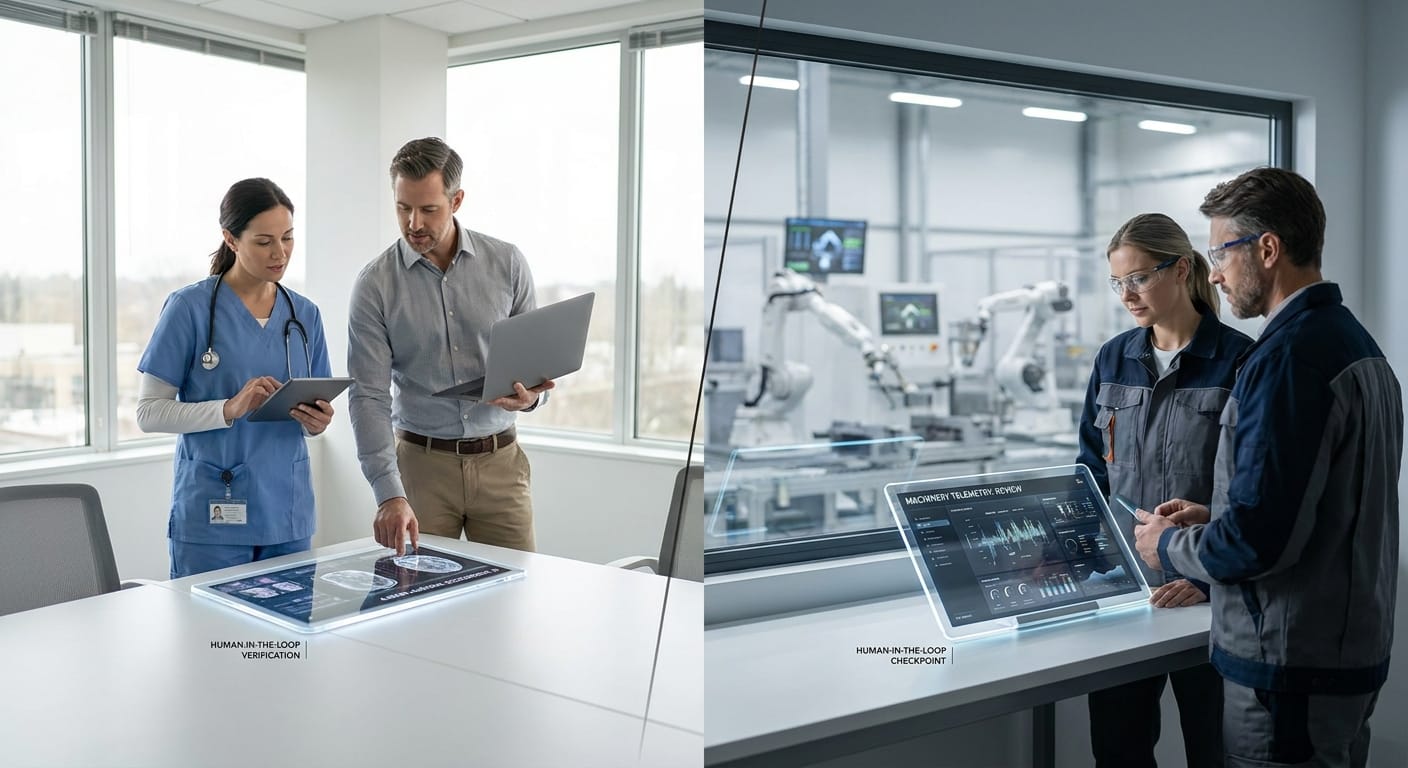
- Precision Healthcare: In clinical settings, our orchestrated models cross-reference pathology slides against millions of historical scans in milliseconds. The model highlights anomalies and surfaces relevant medical literature, yet the final diagnostic sign-off remains firmly with the oncologist. The result is accelerated diagnosis without compromising patient safety.
- Industrial Manufacturing: On factory floors, IoT telemetry feeds into predictive models to identify component degradation weeks before failure. On-site field technicians receive synthesized diagnoses on handheld devices, inspect the physical assets, and confirm maintenance actions, eliminating catastrophic plant halts.
- Knowledge and Field Services: Customer support teams transition from repetitive scripted responders into empowered relationship managers. The machine drafts hyper-contextualized resolutions based on internal knowledge graphs, while the human agent reviews and delivers the final response with genuine empathy.
As highlighted in insights from Harvard Business Review, the companies realizing the highest valuation premiums from artificial intelligence are not those replacing their workforces, but those redesigning their operations around collaborative human-machine teams.
The Strategic Road Ahead for Visionary Leaders
If you take one lesson from my decades in software delivery, let it be this: do not mistake compute speed for strategic wisdom. Artificial intelligence is an extraordinary force multiplier, but multiplying zero direction or zero ethical oversight yields zero business value. The future does not belong to fully autonomous monoliths, nor does it belong to organizations that stubbornly reject algorithmic assistance.
The competitive moat belongs entirely to leaders who master orchestration. By combining reliable, enterprise-grade AI models with the irreplaceable instinct, empathy, and ethical governance of human professionals, your business can achieve breakthrough efficiency while reinforcing data security.
As you map out your technological priorities for the coming quarters, audit your current automation pipeline. Identify where your algorithms are operating unchecked, schedule an architectural review with your engineering leads, and evaluate whether your data governance standards are prepared for next-generation sovereign models. Begin that dialogue today, and build an enterprise ecosystem engineered to endure.