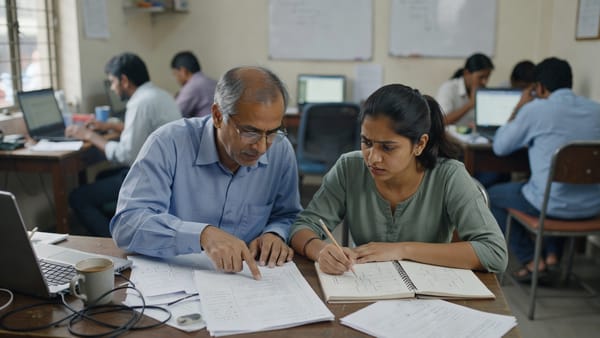




































































































Somewhere around the sixtieth prompt, something breaks that wasn't broken before. Not the feature the founder was just trying to fix — a different one, three screens away, that had been working fine for two weeks. They didn't touch it. They just asked the AI to change the checkout button color, and now the login page redirects to a blank screen.
I'm Sandeep Mundra, and running a software company for as long as I have means I get a version of this same phone call every few months, usually from a first-time founder who sounds equal parts embarrassed and furious. They built something real. It looked finished. And now it's coming apart in a way they can't explain and can't fix, because "fixing" has only ever meant typing another instruction into a box.
The Myths That Get Founders Into This Position
The first myth is that AI app builders removed the need for software engineering. They didn't. They removed the need for a founder to write the first draft themselves, which is a different and much smaller thing. Bolt and Lovable are extraordinary at generating a working prototype from a plain-English description. Neither one is designed to hold a growing system's architecture in its head the way a person can.
The second myth is that "Try Again" is a neutral action, like undo. It isn't. Every retry re-generates code against the current state of the project, and the current state is whatever the last twelve retries left behind. Ask for a small change and the model doesn't edit one file — it often reasons about the whole surface area again, and reasoning about a messier surface produces messier output. The tool isn't getting worse. The ground it's standing on is.
The third myth, and the one that costs the most, is that more specific prompting fixes the problem. Founders start writing paragraph-long instructions, capitalizing key words, adding "DO NOT BREAK ANYTHING ELSE" in bold. I've watched people spend four hours writing the perfect prompt for a bug that a developer would have found in the source file in six minutes, because the developer isn't guessing at the codebase through a chat window — they can just read it.
What Is Actually Happening Inside an AI-Built Codebase Under Repeated Prompting?
An AI-built codebase degrades under repeated prompting because each new instruction is generated without full certainty about every downstream dependency, so small, undetected conflicts accumulate until a previously stable feature breaks from an unrelated change. This is technical debt forming at a speed no solo founder has ever had to manage before.
Why speed and debt grow together
Traditional software teams accumulate debt over quarters, and they usually have a code reviewer or a senior engineer flagging risky shortcuts before they compound. A founder working alone in Replit or Bolt has none of that. They can generate in an afternoon what would have taken a junior developer three weeks, and none of it gets reviewed by anyone who understands what "reviewed" would even mean here.
A founder I'll call Priya — a composite of several people I've advised, not any one person — spent six weeks building a subscription-box logistics tool in Lovable. She had no engineering background, just a sharp sense of what her warehouse team needed. By week four she had inventory tracking, order routing, and a barcode scan flow, all built through prompts, and it worked well enough that she started onboarding her first real customer. By week six, fixing a shipping label bug had quietly broken the barcode scanner, and fixing the scanner broke the order routing logic that depended on a table structure the AI had rewritten twice without her noticing. She hadn't done anything wrong. She'd just run out of runway between what a prompt can see and what the system had become.
Where the psychological toll actually starts
The technical damage is recoverable. The harder part is what happens to the founder's confidence once they stop trusting their own product. They start apologizing to customers before demos. They avoid showing the app to investors who might click the wrong thing. That erosion happens faster than the code breaks, and it's the real reason "just prompt it more" stops working long before the tool technically fails — the founder has already started flinching.
| The expensive mistake to avoid. Don't keep prompting past the second unrelated breakage in one session. That's the signal the model is now patching over its own patches, and every additional retry buries the real bug one layer deeper for whoever fixes it next. |
The Six-Step Sequence That Actually Recovers a Stalled AI-Built Product
Recovering a product stuck in prompt exhaustion follows a specific order, and skipping steps is what turns a two-day fix into a two-week one.
- Stop prompting immediately. Every additional retry changes the baseline a human engineer will have to read.
- Export or pull the raw codebase from GitHub or wherever the builder stores it, even if you've never opened a code editor in your life.
- Get a working engineer to read it before touching it. Diagnosis before surgery, always — the instinct to "just fix the button" first is how second bugs get introduced.
- Separate what's salvageable from what needs a rewrite. In my experience it's usually 70-80% of the product, not the 10% a panicked founder assumes.
- Set up real version control and a staging environment if the founder skipped it, which almost everyone building solo through a prompt box does.
- Hand back a smaller, sturdier prompting surface — engineers can often rebuild guardrails so the founder can keep prompting for small UI changes without risking the core logic again.
An Industry View on Why This Pattern Keeps Repeating
Every founder who calls me expects to hear that they should have hired an engineer from day one. I don't think that's right, and I'll say the unpopular part plainly: building the first version in Lovable, Bolt, or Replit was probably the correct call. It's cheap, it's fast, and it forces a founder to think through their own product before paying anyone to build it. The mistake isn't starting there. The mistake is treating the AI builder as the whole company's engineering department indefinitely, past the point where the product has real users and real consequences for downtime.
| I stopped being scared of my own app the day someone else finally read the code. I'd been treating every bug like it was my fault for not phrasing the prompt right. |
The founders who recover fastest aren't the ones who prompt more carefully. They're the ones who notice the sunk cost pulling at them — six weeks of nights and weekends feels too valuable to hand to a stranger — and hand it over anyway, before the fourth or fifth unrelated feature goes down. Y Combinator partners have started saying the same thing publicly to their batches: ship fast with AI, then bring in real engineering the moment the product has to hold weight. That's not a knock on the tools. It's just what "MVP" has always meant — minimum, not final.
If you're staring at a product that won't take one more retry, the next conversation worth having isn't with the AI builder. It's with an engineer who can read what you've already built and tell you, plainly, what's worth keeping.
Frequently asked questions
What is prompt exhaustion in AI app building?
Prompt exhaustion is the state where repeated prompts to an AI builder like Lovable or Bolt stop reliably improving a product and instead start breaking unrelated features, because the underlying codebase has accumulated conflicting changes that a chat instruction can no longer safely resolve.
Why does fixing one bug with AI create a new one elsewhere?
AI builders often regenerate code against the entire current project state rather than editing a single isolated file, so a change meant for one feature can quietly alter logic or data structures another feature depends on, especially after many prior edits have already made the codebase inconsistent.
When should a non-technical founder hire a software engineer instead of continuing to prompt?
Bring in an engineer once a retry breaks a second unrelated feature in the same session, once a paying customer reports a bug that can't be reproduced, or as soon as the founder feels afraid to demo the product live — all three are signs the codebase, not the prompt, is the problem.